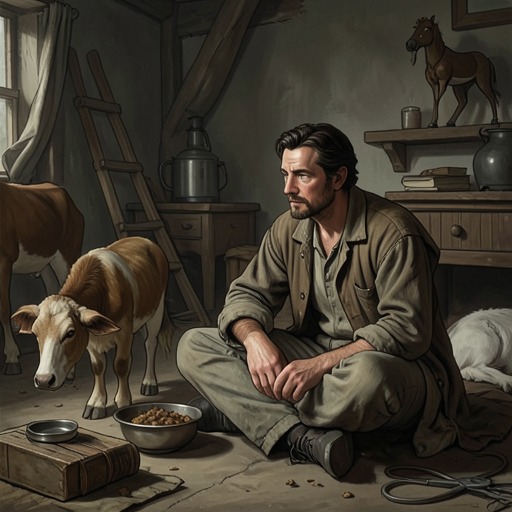
Healthy Self-Love
Thus Spoke ZarathustraHealthy Self-Love is Zarathustra’s answer to the heaviness that keeps a person earthbound: not indulgence or self-flattery, but the patient capacity to remain with oneself and discover what one can become. In his teaching, self-love makes lightness and flight possible, while the appeal to love one’s neighbour can disguise evasion and oppression. Its force lies in turning inward without retreating from life: the self must be borne, examined, and cultivated before it can rise.
Definition and Purpose
Zarathustra introduces self-love in the image of someone who wishes to become light and birdlike. The Spirit of Gravity calls earth and life heavy; against this burden, Zarathustra teaches that a person must love himself. The contrast makes self-love more than a sentiment. It is a condition of movement: without it, the person remains fixed under inherited weight; with it, becoming light and taking flight become imaginable.
The image also gives the teaching a direction beyond private contentment. Zarathustra describes the one who will teach people to fly as moving boundary-stones and baptizing the earth anew as weightless. Healthy self-love belongs to this larger transformation: it enables a different relation to life and to the limits people have treated as immovable. The lesson is not that the earth should be abandoned, but that the burdened way of inhabiting it can be overcome.
Against Sickness and False Neighbour-Love
Zarathustra explicitly distinguishes this love from the love of the sick and diseased, for whom self-love itself has become foul. The qualification prevents his teaching from being reduced to automatic approval of whatever the self already is. The kind of love he advocates must be sound enough to sustain a person, rather than intensify sickness or turn inwardness into a disguise for it.
Its practical test is whether a person can endure being with himself instead of roaming elsewhere. Zarathustra presents such roaming as something that calls itself love of one’s neighbour; he adds that these words have served lying and dissembling, especially among people oppressive to everyone. Neighbour-love is therefore not condemned in every form. The passage targets its use as a respectable mask: a person may profess concern for others while avoiding the more difficult work of inhabiting and understanding the self. Healthy self-love exposes that evasion by asking whether the supposed generosity is grounded in strength or is merely an escape.
An Art of Patience and Discovery
Zarathustra insists that learning self-love is not a commandment for today or tomorrow. He calls it a fine, subtle, ultimate, and patient art. That duration matters: the self is not immediately transparent to its possessor, and cannot be recovered through a single declaration of independence. The work involves learning to live alongside oneself rather than fleeing whenever that closeness becomes difficult.
The obstacle is concealment. Zarathustra says that possessions are hidden from their possessor and that one’s own treasure-pit is the last to be dug out; he names the Spirit of Gravity as the cause. The metaphor joins self-knowledge to effort: what matters most is close at hand, yet buried beneath the weight that makes it hard to reach. He traces that weight back to childhood, when people are almost still in the cradle presented with heavy words and values called Good and Evil. Healthy self-love thus requires patience not only with one’s immediate feelings but with the inherited valuations that have shaped how life itself is judged.
Courage, Obedience, and the Work of Becoming
Elsewhere, Zarathustra places related demands on those he addresses as warriors. He calls himself both their kind and their best enemy, and says that those they love should not spare them from truth. He also recasts nobility: rebellion may show a slave’s nobility, while a warrior’s nobility appears in obeying; even command, he says, can be a form of obedience. These formulations make self-overcoming more complex than simply following one’s wishes. The teaching of self-love belongs to a demanding ethic in which a person must learn what to serve and must first command what is dear to him.
Zarathustra also directs love of life toward one’s highest hope, which is to be the highest idea of life. In another address, he distinguishes courage from coldness, blindness, or intoxication: the courageous person knows fear and masters it, sees the abyss with pride, and meets it with an eagle’s gaze and grasp. This image offers a useful counterpoint to the idea of flight. Healthy self-love is not a flight from difficulty; it supports the courage to face what is frightening without surrendering to it.
The surrounding discourse also shows that Zarathustra’s language of self-transformation is framed through gendered ideals. In Of Old and Young Women, he says that man should be trained for war and woman for the warrior’s recreation. That formulation is distinct from the teaching on self-love, but it reveals the martial vocabulary in which the book often stages strength, danger, and becoming. Against that wider background, Healthy Self-Love is not a soothing conclusion. It is one of the difficult arts by which a person might cease to be governed by inherited heaviness, remain with himself, and open a path toward a higher way of living.